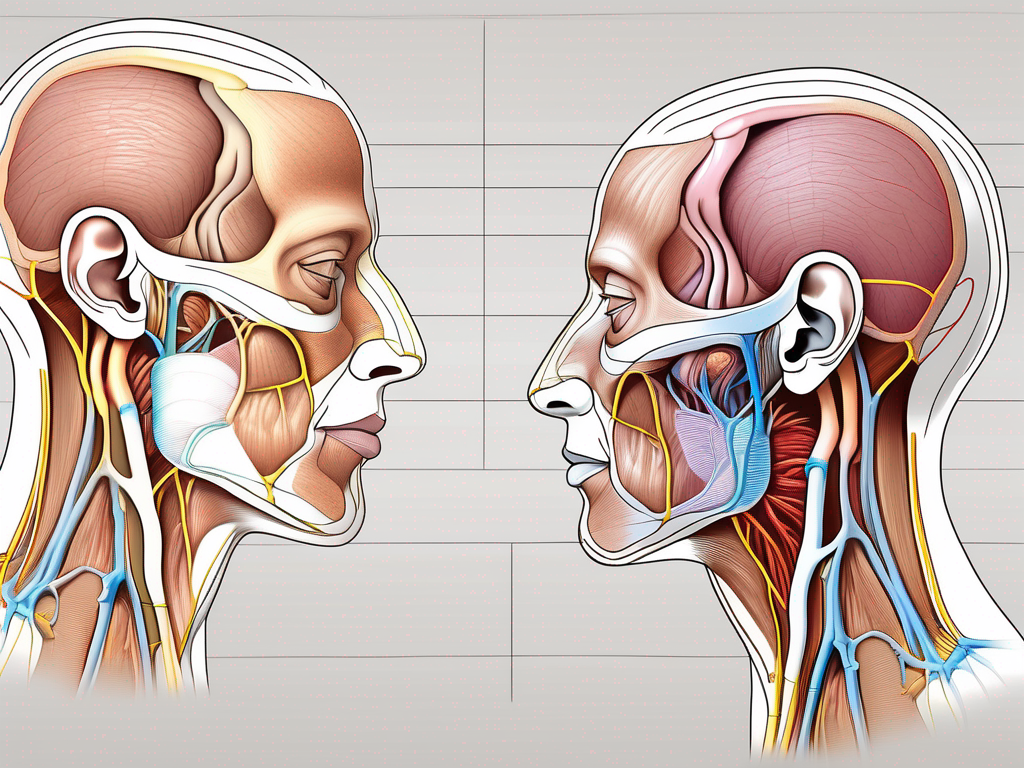
The greater auricular nerve is an important structure located in the head and neck region. To understand its significance, it is crucial to delve into the anatomy of this nerve.
Understanding the Anatomy of the Greater Auricular Nerve
The greater auricular nerve is a branch of the cervical plexus, which is a network of nerves originating from the spinal cord in the neck. It is composed of sensory fibers that provide innervation to certain areas of the skin in the head and neck.
The greater auricular nerve plays a crucial role in the sensation of the head and neck region. It is responsible for transmitting sensory information from the skin to the brain, allowing us to perceive touch, temperature, and pain in these areas.
But what exactly is the structure of the greater auricular nerve? Let’s delve deeper into its anatomy.
The Structure of the Greater Auricular Nerve
The greater auricular nerve arises from the C2 and C3 spinal nerves, and it has a unique branching pattern. It travels along the posterior border of the sternocleidomastoid muscle, located on the side of the neck. The nerve then ascends towards the ear, where it divides into smaller branches.
As the nerve travels along the sternocleidomastoid muscle, it gives off branches that supply sensation to the skin overlying the muscle itself. These branches play a crucial role in providing sensory feedback, allowing us to perceive touch and pressure in this area.
Upon reaching the ear, the greater auricular nerve further divides into smaller branches that innervate specific regions. One of these branches extends towards the area around the earlobe, while another branch extends towards the angle of the jaw. These branches ensure that the skin in these regions is adequately supplied with sensory fibers, allowing us to perceive touch, temperature, and pain in these areas.
The Origin and Termination of the Greater Auricular Nerve
The greater auricular nerve arises from the cervical plexus, which is formed by the ventral rami (thick branches) of the C1-C4 spinal nerves. This plexus is a complex network of nerves that supplies various regions of the head and neck.
After branching off from the cervical plexus, the greater auricular nerve begins its journey towards the ear. Along its course, it receives contributions from other nerves, ensuring that it carries a diverse range of sensory information.
Finally, the greater auricular nerve terminates in the skin overlying the ear, specifically in the area around the earlobe and the angle of the jaw. This termination point is strategically located to provide comprehensive sensory innervation to these regions, allowing us to perceive touch, temperature, and pain with precision.
In conclusion, the greater auricular nerve is a fascinating component of the cervical plexus. Its unique branching pattern and termination points make it a vital player in the sensation of the head and neck region. Understanding its anatomy is crucial for healthcare professionals and researchers alike, as it helps shed light on the intricate network of nerves that contribute to our sensory experiences.
The Function of the Greater Auricular Nerve
The primary function of the greater auricular nerve is sensory. It carries sensory information from the skin it innervates to the brain, allowing for the perception of touch, pain, and temperature in the respective areas.
Sensory Role of the Greater Auricular Nerve
The greater auricular nerve provides sensation to the skin on the side of the face, extending from the earlobe to the angle of the jaw. This includes the skin over the parotid gland (located in front of the ear) and the outer ear.
When the greater auricular nerve is stimulated, it sends signals to the brain, allowing us to feel various sensations on the side of our face. For example, when someone touches our earlobe, the greater auricular nerve carries the information of that touch to the brain, allowing us to perceive the sensation of touch on our earlobe.
In addition to touch, the greater auricular nerve also plays a crucial role in the perception of pain. If we accidentally bump our jaw against a hard surface, the nerve quickly transmits the pain signals to the brain, alerting us to the injury and prompting us to take necessary actions to protect the affected area.
Temperature sensation is another important function of the greater auricular nerve. It allows us to perceive changes in temperature on the side of our face. For instance, when we touch a hot object, the nerve rapidly transmits the information to the brain, warning us of the potential danger and triggering a reflexive withdrawal of our hand.
Connection to the Cervical Plexus
The greater auricular nerve is part of the cervical plexus, a network of nerves that supplies the head, neck, and upper shoulder region. It works in conjunction with other nerves of the cervical plexus to provide comprehensive sensory innervation to these areas.
The cervical plexus is formed by the merging of the ventral rami of the first four cervical nerves. These nerves join together to form a complex network that branches out to various regions of the head and neck. The greater auricular nerve, originating from the second and third cervical nerves, is one of the major branches of the cervical plexus.
Together with other nerves of the cervical plexus, the greater auricular nerve ensures that the head, neck, and upper shoulder region receive adequate sensory input. This allows us to perceive sensations from these areas, such as touch, pain, and temperature, enabling us to interact with our environment effectively.
Furthermore, the cervical plexus is also involved in motor functions, controlling the movement of certain muscles in the head and neck. It works in harmony with the sensory functions of the greater auricular nerve, ensuring coordinated and efficient functioning of the entire region.
The Greater Auricular Nerve and Pain Management
Due to its sensory role, the greater auricular nerve has implications in pain management and surgical procedures.
The greater auricular nerve, also known as the auricular branch of the cervical plexus, is a sensory nerve that supplies the skin over the external ear and the parotid gland. It arises from the second and third cervical nerves and travels superficially along the posterior border of the sternocleidomastoid muscle before branching out into smaller nerves that innervate the designated areas.
When it comes to surgical procedures in the head and neck region, surgeons often take into consideration the greater auricular nerve. Its proximity to the surgical site necessitates careful manipulation to avoid nerve injury and potential complications. The nerve can be vulnerable during procedures such as parotid gland surgery, facelifts, and reconstructive surgeries in the head and neck area.
During surgery, the surgeon must be cautious not to damage or stretch the greater auricular nerve. Injury to the nerve can result in sensory disturbances, such as numbness, tingling, or pain in the distribution area. In some cases, nerve injury can lead to long-term complications, affecting the patient’s quality of life.
Role in Surgical Procedures
Surgeons often take into consideration the greater auricular nerve when performing various procedures in the head and neck region. Its proximity to the surgical site necessitates careful manipulation to avoid nerve injury and potential complications.
For example, in parotid gland surgery, the greater auricular nerve needs to be identified and protected to prevent damage. The nerve can be retracted or preserved, depending on the nature of the surgery and the patient’s specific condition. Surgeons may use intraoperative nerve monitoring techniques to ensure the nerve’s integrity during the procedure.
Similarly, in facelift surgeries, the greater auricular nerve can be at risk due to the extensive dissection and repositioning of facial tissues. Surgeons must be mindful of the nerve’s location and take appropriate measures to safeguard its function.
Implications for Chronic Pain
In some cases, the greater auricular nerve can be implicated in chronic pain conditions, such as neuralgia. Neuralgia refers to a condition characterized by sharp, shooting, or burning pain along the path of a nerve. If you experience persistent pain or discomfort along the path of the greater auricular nerve, it is advisable to consult with a healthcare professional who specializes in pain management.
A thorough evaluation by a pain management specialist can help determine the underlying cause of the pain. They may perform diagnostic tests, such as nerve conduction studies or imaging, to assess the nerve’s condition. Based on the findings, appropriate treatment options can be recommended.
Treatment for greater auricular nerve-related pain may include medications to alleviate nerve pain, such as anticonvulsants or tricyclic antidepressants. Physical therapy, nerve blocks, or radiofrequency ablation may also be considered to provide relief. In some cases, surgical interventions, such as nerve decompression or neurectomy, may be necessary to address the underlying cause of the pain.
It is important to remember that each case is unique, and treatment plans should be tailored to individual needs. Consulting with a pain management specialist can help ensure a comprehensive approach to managing greater auricular nerve-related pain and improving overall quality of life.
Disorders Related to the Greater Auricular Nerve
Damage or dysfunction of the greater auricular nerve can lead to specific symptoms and may require medical attention for diagnosis and treatment.
Symptoms of Greater Auricular Nerve Damage
When the greater auricular nerve is injured or compressed, it can result in symptoms such as pain, numbness, or altered sensation in the areas it innervates. These symptoms may be localized to the region around the earlobe and angle of the jaw.
Diagnosis and Treatment Options
If you suspect you have greater auricular nerve damage, it is essential to consult with a healthcare professional who can perform a comprehensive assessment. Diagnostic techniques, such as physical examination and imaging studies, may be employed to confirm the diagnosis. Treatment options will depend on the underlying cause and severity of the nerve damage, and may include medication, physical therapy, or surgical intervention. It is important to follow the guidance of a qualified healthcare provider in managing these conditions.
The Greater Auricular Nerve in the Context of the Nervous System
Interactions between the greater auricular nerve and other nerves, as well as its relationship with the spinal cord, play an integral role in the functioning of the nervous system.
Interactions with Other Nerves
The greater auricular nerve is just one component of the vast network of nerves that comprise the human nervous system. It interacts with other cranial and spinal nerves to facilitate complete sensory perception and motor function in the head and neck region.
The Greater Auricular Nerve and the Spinal Cord
The greater auricular nerve connects to the spinal cord through the cervical plexus. This intricate connection allows sensory information from the skin to be transmitted to the brain for processing and interpretation. It highlights the close relationship between the peripheral nerves and the central nervous system.
In conclusion, the greater auricular nerve is a significant structure located in the head and neck region. It provides sensory innervation to specific areas and plays a vital role in pain management and various surgical procedures. If you experience symptoms or suspect nerve damage, consulting with a healthcare professional is crucial for an accurate diagnosis and appropriate treatment.
Leave a Reply