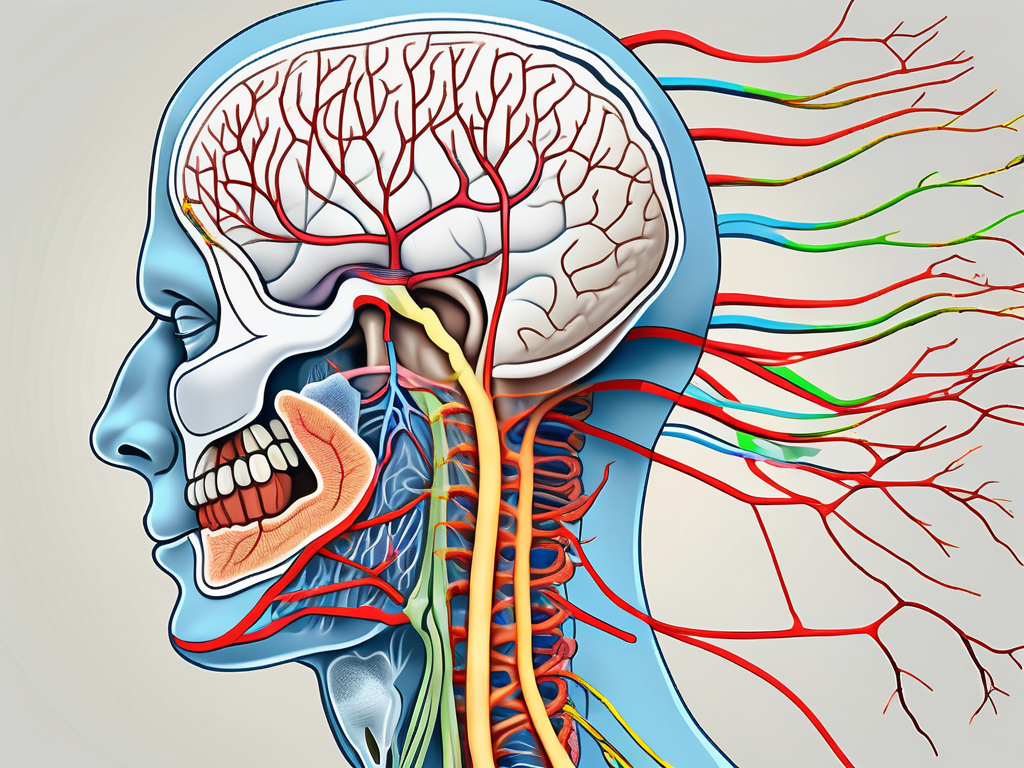
Medical science constantly strives to deepen our understanding of the intricate workings of the human body. One area of particular interest is the greater auricular nerve, which plays a crucial role in both sensory perception and surgical procedures involving the head and neck. By delving into the anatomy, function, disorders, and future research directions of this important nerve, we can gain valuable insights into its significance in the field of medicine.
Anatomy of the Greater Auricular Nerve
The greater auricular nerve is a branch of the cervical plexus, arising primarily from the cervical nerves C2 and C3. It emerges from the posterior border of the sternocleidomastoid muscle and ascends towards the ear, giving rise to several branches along its pathway. The nerve contains both sensory and motor fibers, with its sensory component being of particular significance in medical science.
The greater auricular nerve is a fascinating structure that plays a crucial role in the innervation of the head and neck region. Let’s delve deeper into its origin, pathway, branches, and distribution to gain a comprehensive understanding of its importance.
Origin and Pathway of the Greater Auricular Nerve
The greater auricular nerve originates from the upper cervical roots, specifically C2 and C3. These roots are part of the cervical plexus, a network of nerves that supplies various structures in the neck and head. From its origin, the greater auricular nerve travels laterally across the posterior triangle of the neck, traversing through layers of fascia, muscles, and other anatomical structures.
As the greater auricular nerve ascends towards the ear, it takes a fascinating course, innervating specific regions along the way. One of its notable destinations is the skin over the parotid gland, a major salivary gland located in front of the ear. The nerve also provides sensory innervation to the angle of the mandible, the bony prominence at the lower jaw’s posterior end.
Continuing its journey, the greater auricular nerve divides into anterior and posterior branches. These branches further extend their reach, supplying sensory fibers to the external ear, the region behind the ear, and the skin over the mastoid process. This intricate distribution of sensory innervation allows for the perception of various sensations in these areas.
Branches and Distribution of the Greater Auricular Nerve
While the greater auricular nerve primarily innervates the skin of the external ear and surrounding regions, its influence extends beyond just sensory perception. It also sends branches to the parotid gland and the angle of the mandible, contributing to the overall functionality of these structures.
The branches that reach the parotid gland play a crucial role in its innervation. This gland is responsible for producing saliva and is involved in the process of digestion. The sensory fibers provided by the greater auricular nerve’s branches allow for the perception of sensations in this region, aiding in the detection of any abnormalities or changes that may occur.
In addition to the parotid gland, the angle of the mandible also receives innervation from the greater auricular nerve. This bony prominence serves as an attachment point for various muscles involved in chewing and speaking. The sensory fibers from the nerve’s branches in this area contribute to the overall sensory perception and functionality of the mandible.
Understanding the branches and distribution of the greater auricular nerve is not only significant in terms of sensory perception but also in the field of neurosurgery. The detailed knowledge of this nerve’s anatomy allows for precise surgical procedures in the head and neck region, ensuring optimal outcomes for patients undergoing neurosurgical interventions.
Role of Greater Auricular Nerve in Sensory Perception
The greater auricular nerve plays a significant role in sensory perception, providing vital innervation to two important areas: the ear and the skin.
The greater auricular nerve, a branch of the cervical plexus, is responsible for transmitting sensory information from various regions of the head and neck to the brain. Its intricate network of nerve fibers enables us to perceive and interpret different sensations, allowing us to interact with our environment.
Sensory Innervation of the Ear
The sensory fibers of the greater auricular nerve provide cutaneous innervation to the external ear and the region behind it. This innervation contributes to our ability to perceive touch, temperature, and pain in these areas. When we gently touch our earlobe or feel the warmth of the sun on our ears, it is the greater auricular nerve that relays these sensations to our brain, creating a rich sensory experience.
Furthermore, the greater auricular nerve is responsible for transmitting pain signals from the ear. When we accidentally pierce our ear with an earring or experience an ear infection, the nerve fibers of the greater auricular nerve quickly send distress signals to our brain, alerting us to potential harm and prompting us to seek appropriate medical attention.
Sensory Innervation of the Skin
In addition to its role in ear innervation, the greater auricular nerve also supplies sensory fibers to the skin over the parotid gland and the angle of the mandible. This innervation allows us to perceive sensations in these regions, including touch, pressure, and temperature changes.
When we gently stroke the skin over the parotid gland, we can feel the softness and smoothness of our skin, thanks to the sensory fibers of the greater auricular nerve. Similarly, when we place our hand on the angle of our mandible, we can sense the pressure and temperature of our touch, enhancing our awareness of our physical surroundings.
Any abnormalities or symptoms related to these areas should prompt consultation with a medical professional. If there is a disruption in the function of the greater auricular nerve, such as nerve compression or injury, it can lead to sensory disturbances. These disturbances may manifest as numbness, tingling, or altered sensation in the ear, parotid gland, or angle of the mandible. Seeking medical attention can help diagnose and address any underlying issues, ensuring optimal sensory perception and overall well-being.
Greater Auricular Nerve in Surgical Procedures
The role of the greater auricular nerve extends beyond sensory perception and into the realm of surgical procedures, particularly those involving the head and neck.
The greater auricular nerve, also known as the auricular branch of the cervical plexus, is a sensory nerve that supplies the skin of the external ear and the adjacent areas of the scalp. While its primary function is to provide sensory perception, it has significant implications in various surgical interventions.
Importance in Head and Neck Surgeries
During head and neck surgeries, such as parotidectomy or neck dissection, the greater auricular nerve plays a crucial role. Surgeons must carefully navigate around this nerve to minimize the risk of nerve damage and subsequent post-operative complications.
The greater auricular nerve runs a superficial course along the posterior border of the sternocleidomastoid muscle, ascending towards the external ear. Its close proximity to the surgical field requires meticulous dissection and preservation techniques to avoid injury. Surgeons must have a comprehensive understanding of the nerve’s anatomy and its relationship to surrounding structures, including the parotid gland and lymph nodes, to ensure successful surgical outcomes.
Role in Nerve Block Procedures
The greater auricular nerve also serves as an important target for nerve block procedures. By selectively anesthetizing this nerve, healthcare providers can achieve localized pain control in the external ear and surrounding areas.
Nerve blocks involving the greater auricular nerve are commonly performed in various clinical scenarios, such as postoperative pain management, chronic headache syndromes, and certain dermatological procedures. The procedure involves the injection of a local anesthetic agent near the nerve, effectively blocking its sensory function.
However, it is crucial to note that nerve blocks should only be performed by qualified professionals, such as anesthesiologists or pain management specialists. Improper administration or management of nerve blocks could have detrimental effects, including infection, bleeding, or nerve damage.
In conclusion, the greater auricular nerve plays a vital role in both surgical procedures and nerve block interventions. Its intricate anatomy and close proximity to critical structures necessitate careful consideration and skillful maneuvering during surgical interventions. Additionally, the selective blockade of this nerve offers effective pain control in specific clinical scenarios, but should always be performed by experienced healthcare professionals to ensure patient safety and optimal outcomes.
Greater Auricular Nerve Disorders
While the greater auricular nerve is generally resilient, certain disorders and conditions may affect its function, leading to symptoms and discomfort.
Causes and Symptoms of Greater Auricular Neuritis
Greater auricular neuritis, also known as neuralgia, is characterized by inflammation or damage to the nerve. This condition can arise from various causes, including trauma, infections, and autoimmune disorders. Symptoms may include pain, tingling, numbness, or hypersensitivity in the areas innervated by the nerve. Individuals experiencing these symptoms should seek medical evaluation to determine the underlying cause and appropriate treatment options.
Diagnosis and Treatment of Greater Auricular Nerve Damage
Diagnosing and treating greater auricular nerve damage requires a comprehensive approach. Medical professionals may employ physical exams, medical history reviews, and diagnostic tests to evaluate the extent of the damage and identify the underlying cause. Treatment options may range from conservative measures, such as pain management and physical therapy, to surgical interventions, depending on the severity of the damage and the specific clinical scenario.
Future Research Directions for Greater Auricular Nerve
The greater auricular nerve continues to capture the attention of researchers and medical professionals, who are continuously exploring new avenues for understanding its intricate functions and potential therapeutic applications.
Potential Therapeutic Targets
Researchers are actively investigating potential therapeutic targets associated with the greater auricular nerve. By unraveling the molecular and cellular mechanisms underlying its function, scientists hope to identify novel treatment approaches for various conditions, including sensory disorders and pain management.
Technological Advancements in Nerve Study
The field of nerve study has witnessed remarkable technological advancements in recent years. Modern imaging techniques, such as magnetic resonance imaging (MRI) and nerve conduction studies, allow for detailed visualization and assessment of the greater auricular nerve, enhancing diagnostic accuracy and therapeutic planning. These technological advancements continue to push the boundaries of our understanding and pave the way for more targeted and precise interventions.
Understanding the importance of the greater auricular nerve roots in medical science is essential for healthcare providers and scientists alike. By exploring its anatomy, function, disorders, and future research directions, we can continue to expand our knowledge and improve patient care. However, it is crucial to remember that specific medical advice should only be provided by qualified professionals, and individuals experiencing symptoms should consult with their healthcare providers for appropriate evaluation and management.
Leave a Reply