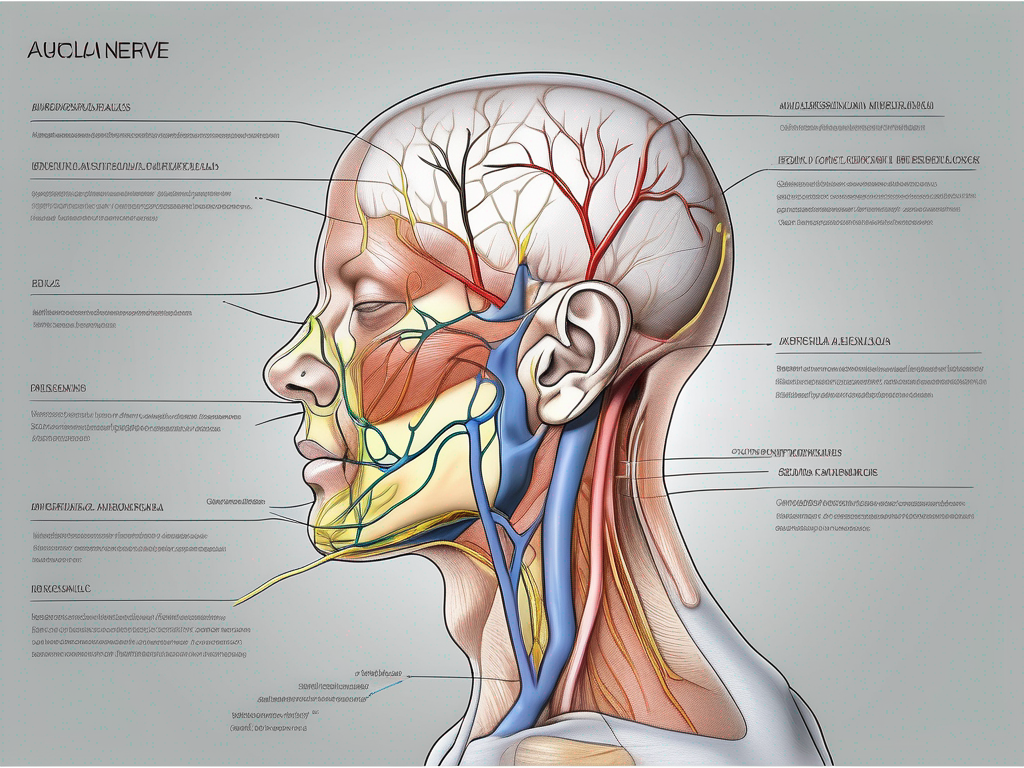
The great auricular nerve plays a crucial role in the cutaneous innervation of the head and neck region. By understanding its anatomy, functions, and clinical significance, one can appreciate its importance in medical practice. This article aims to provide a comprehensive overview of the great auricular nerve, its innervation, and associated disorders.
Anatomy of the Great Auricular Nerve
The great auricular nerve is a significant nerve in the human body, playing a crucial role in the sensory innervation of the face and neck region. Understanding its origin, course, and distribution is essential for comprehending its physiological significance.
Origin and Course of the Great Auricular Nerve
The great auricular nerve arises from the cervical plexus, a complex network of nerves formed by the ventral rami of the second and third cervical spinal nerves. This plexus is located deep within the neck, nestled between the anterior scalene and sternocleidomastoid muscles.
As the great auricular nerve emerges from the cervical plexus, it descends posteriorly towards the sternocleidomastoid muscle, one of the major muscles responsible for neck movements. Along its course, the nerve traverses through the intricate anatomical structures of the neck, intertwining with blood vessels, lymph nodes, and other nerves.
Continuing its journey, the great auricular nerve then ascends obliquely towards the external ear, following a path that allows it to reach its intended destination. This trajectory ensures optimal distribution of sensory information to the surrounding tissues, providing a vital connection between the external environment and the central nervous system.
It is worth noting that as the great auricular nerve courses through the neck, it may give rise to branches that supply the adjacent tissues. These branches, known as collateral branches, contribute to the overall functionality and complexity of the nerve, ensuring comprehensive sensory innervation in the region.
Branches and Distribution of the Great Auricular Nerve
The main distribution of the great auricular nerve lies in the face and neck region, making it a critical component of the sensory network in this area. Its intricate branching pattern allows for precise and efficient sensory innervation of various structures.
One of the primary areas supplied by the great auricular nerve is the skin overlying the parotid gland, a salivary gland located in front of the ear. This sensory innervation ensures that any changes or stimuli in this area are promptly relayed to the brain, allowing for appropriate responses and reactions.
In addition to the parotid gland, the great auricular nerve also provides sensory innervation to the external ear, including the auricle and the surrounding skin. This allows for the perception of touch, temperature, and pain in this delicate and exposed region.
Furthermore, the nerve extends its reach to the mastoid process, a prominent bony projection located behind the ear. By supplying sensory innervation to this area, the great auricular nerve ensures that any stimuli or sensations originating from the mastoid process are effectively transmitted to the central nervous system.
As if its distribution to the parotid gland, external ear, and mastoid process were not enough, the great auricular nerve also sends branches to the angle of the mandible, the bony prominence at the lower jaw’s posterior end. This additional distribution ensures comprehensive sensory coverage in the face and neck region, leaving no area untouched.
In conclusion, the great auricular nerve is a remarkable anatomical structure that plays a vital role in the sensory innervation of the face and neck region. Its origin, course, and distribution highlight its intricate nature and emphasize its importance in maintaining proper sensory function in these areas.
The Role of the Great Auricular Nerve in Cutaneous Innervation
The great auricular nerve is a crucial component of the peripheral nervous system, playing a vital role in the sensory and motor functions of the ear and its surrounding areas. Understanding the intricacies of this nerve is essential for comprehending the complex mechanisms that govern cutaneous innervation.
Sensory Functions of the Great Auricular Nerve
The great auricular nerve serves as a conduit for sensory information, allowing us to perceive the world around us through our sense of touch. This remarkable nerve is responsible for relaying pain, touch, temperature, and pressure sensations from the skin of the ear and its neighboring regions to the brain.
When the great auricular nerve is functioning optimally, it enables us to experience the gentle caress of a loved one’s hand, the warmth of the sun’s rays on our skin, and the sharp sting of a mosquito bite. However, when this nerve encounters dysfunction or damage, it can lead to altered sensation or even numbness in these areas, robbing us of the ability to fully experience the rich tapestry of sensory stimuli that surround us.
Motor Functions of the Great Auricular Nerve
Although primarily a sensory nerve, the great auricular nerve also plays a role in motor functions in certain cases. Within its intricate network of branches, some contain motor fibers that innervate specific muscles in the area, such as the muscles of the external ear.
These motor fibers, intricately intertwined within the great auricular nerve, allow us to perform subtle movements of the external ear, an often-overlooked aspect of our body’s remarkable capabilities. These movements, though seemingly insignificant, contribute to our ability to express emotions, communicate non-verbally, and even aid in sound localization.
However, when these motor fibers are affected by dysfunction or damage, deficits in motor function may occur. This can manifest as difficulties in moving the external ear, resulting in a loss of expressive capabilities and potentially impacting our overall communication abilities.
In conclusion, the great auricular nerve is a multifaceted component of our nervous system, intricately involved in both sensory and motor functions. Its role in cutaneous innervation cannot be overstated, as it allows us to perceive and interact with the world around us. Understanding the complexities of this nerve is not only fascinating but also crucial for diagnosing and treating any potential dysfunctions that may arise.
Clinical Significance of the Great Auricular Nerve
The great auricular nerve plays a crucial role in the sensory innervation of the ear and surrounding areas. It originates from the cervical plexus, specifically the second and third cervical nerves. This nerve provides sensation to the skin over the parotid gland, the external ear, and the angle of the mandible. Understanding the clinical significance of the great auricular nerve is essential in diagnosing and managing various disorders that may affect it.
Common Disorders Involving the Great Auricular Nerve
Various conditions can affect the great auricular nerve, leading to potential complications. These disorders include trauma, compression, and inflammation.
Traumatic injuries, such as neck surgeries or accidents, may damage the nerve, causing pain, numbness, and altered sensation. The nerve can be stretched, compressed, or severed during surgical procedures, leading to temporary or permanent dysfunction. In cases of accidents, direct trauma to the nerve can result in immediate symptoms or delayed onset of complications.
Compression of the nerve is another common disorder involving the great auricular nerve. This compression can occur due to tight clothing or prolonged pressure on the nerve. Individuals who frequently wear tight headbands or helmets may experience symptoms such as pain, tingling, and numbness in the distribution of the nerve. It is important to identify and address the source of compression to prevent further damage and alleviate symptoms.
Inflammatory conditions, such as infections or autoimmune diseases, may also affect the great auricular nerve. Infections, such as cellulitis or abscesses in the neck, can lead to inflammation and subsequent nerve involvement. Autoimmune diseases, like rheumatoid arthritis or systemic lupus erythematosus, can cause inflammation of the nerves, including the great auricular nerve. These inflammatory processes can result in pain, swelling, and altered sensation in the affected areas.
Diagnostic Procedures for Great Auricular Nerve Conditions
To diagnose disorders involving the great auricular nerve, healthcare professionals employ a combination of clinical examination and diagnostic procedures. Detailed medical history, including potential trauma or compression factors, is crucial in identifying the underlying cause.
Physical examination plays a vital role in assessing the function of the great auricular nerve. Healthcare professionals may perform neurological testing to evaluate the sensory function of the nerve. This may involve assessing the patient’s ability to feel light touch, pinprick, or temperature changes in the distribution of the nerve. Any noticeable abnormalities or deficits can provide valuable information for diagnosis.
In some cases, additional diagnostic tools may be necessary to further evaluate the condition. Imaging studies, such as magnetic resonance imaging (MRI) or computed tomography (CT) scans, can help visualize the anatomy of the nerve and identify any structural abnormalities or signs of compression. Nerve conduction tests, such as electromyography (EMG) or nerve conduction velocity (NCV) studies, can assess the electrical activity and conduction speed of the nerve, providing objective data on its function.
It is essential to consult with a healthcare professional to evaluate and diagnose any potential issues with the great auricular nerve. Early detection and appropriate management can help prevent further complications and improve the overall prognosis for individuals with disorders involving this important nerve.
Treatment and Management of Great Auricular Nerve Disorders
Non-Surgical Treatment Options
Non-surgical approaches are often the first line of treatment for great auricular nerve disorders. These may include pain management techniques, such as medication or physical therapy, to alleviate discomfort and improve function. In some cases, lifestyle modifications, such as avoiding tight clothing or prolonged pressure, may be recommended. It is important to consult with a healthcare professional for an individualized treatment plan based on the specific condition and its severity.
Surgical Interventions for Great Auricular Nerve Disorders
In certain cases, surgical interventions may be necessary to address great auricular nerve disorders. These procedures aim to relieve nerve compression or repair any damage. Surgical options may range from nerve decompression to nerve repair or grafting, depending on the underlying cause and severity of the condition. A thorough evaluation by a healthcare professional is crucial to determine the appropriate surgical approach.
Future Research Directions in Great Auricular Nerve Study
Potential Therapeutic Targets
Advancements in understanding the great auricular nerve’s functions and disorders open up possibilities for future therapeutic targets. Further research may focus on developing novel medications or interventions to specifically target the nerve and improve outcomes for individuals with great auricular nerve-related conditions.
Technological Advances in Great Auricular Nerve Study
Technological advancements, such as imaging techniques and nerve stimulation methods, have the potential to enhance our understanding of the great auricular nerve. These tools allow for more precise and detailed examination of the nerve, leading to improved diagnoses and treatment strategies. Ongoing research and development in this field may provide invaluable insights into the great auricular nerve.
In conclusion, understanding the cutaneous innervation of the great auricular nerve is essential for healthcare professionals dealing with head and neck disorders. Its anatomy, functions, and clinical significance play a significant role in the assessment and management of related conditions. Consulting with a healthcare professional is vital for proper evaluation, diagnosis, and treatment. Ongoing research efforts offer promising opportunities for advancements in this field, ultimately benefiting patients with great auricular nerve-related disorders.
Leave a Reply